


There are some places that refuse to give up the past, even as the glacial passing of time leaves them behind, casting them into obscurity. They have entered the earth with stubborn roots - deep and abiding and dismissive of the tenuous and fleeting memories of the peoples that roam about them. Why is this? Why should this be? Is it that some places are produced from febrile extremes - of love and hate, of fear or disgust, high emotion embedded in the landscape. Some places are born bright and the land remembers them. Some though, were born dark, and they too are remembered.

On Monday 23rd September 1771 William Reynolds killed himself, hanging himself from his bedstead. He had tried before, by cutting his throat some two months earlier, but had been saved - his wound sewn and ‘other remedies’ applied which repaired his body, though not his mind. A man of religion, had taken Reynolds under his wing, a man,
‘very eminent for his exalted talents, piety and learning, as well as for his unwearied diligence in warning obstinate sinners to flee from the wrath to come’[1]
This unnamed divine had seemingly waited on Reynolds, advised him and prayed that he may be forgiven for his ‘enormous crime’ of attempted ‘self murder’. All to no avail.
Reynolds had been a hatter by trade, but at the time of his death was described at the inquest as a pauper, of Marchwiel Parish but living in Wrexham. We do not know the circumstances behind his tragic suicide, there is little in the record of the man before his death. His suicide has defined him. Is it possible that his trade was something of a cause of his death? The phrase, ‘mad as a hatter’ has its origins in the use of mercury nitrate in the process of turning animal fur into felt for hats. Constant exposure to the fumes of the chemical were known to lead to convulsions (known as the hatters shakes), speech problems, hallucinations and mood changes. At his time of death, William Reynolds was thought to be about 70 years of age and on crutches. It is sad to think that perhaps Reynolds had spent most of his life slowly destroying his health, eventually losing his trade as a consequence and ending his days in poverty and terrible mental distress.
Times have changed of course, and suicide is no longer a criminal offence - but that change has taken an age. It was not until 1961 that suicide was deemed to be no longer a crime.[2] The Burial of Suicides Act of 1823 allowed for those having taken their own life to be buried in consecrated ground - if only at night, between 9pm and midnight and without a Christian service. It also explicitly banned the act of driving a stake through the deceased and burying them on highways, at crossroads. But that was 1823, and William Reynolds killed himself over 50 years earlier.
The quickly established inquest, held probably on Saturday 28th September, concluded simply that William had committed ‘self-murder’. As a consequence Reynolds was immediately placed in an open coffin and transported to the church of St Deiniol and St Marcella at Marchwiel, the village of his birth, for a night burial. However, it would seem some of the villagers,
‘being alarmed, and unwilling that such a monster of iniquity should be deposited near their habitations, prevented his being buried that night.’
The burial of suicides in consecrated ground, at night, might have been formalised by the Act of 1823, but by that time it seems it was not unheard of, possibly common for such deaths to be interred in a parish graveyard. Not so, it seems, at Marchwiel. Poor William Reynolds was thus left within his open coffin by the churchyard, through the whole of the following day, this being a Sunday, while it was decided what to do with him.
Come the Monday, the 30th September, a decision had been made. The coffin and Reynolds within it were taken from the church to what was described as ‘an obscure cross-lane, near a place called Street-yr-Hwch’ and buried there. This spot later became known as Reynolds Grave - a little north of the area more properly known as Stryt-yr-hwch. A story later told by Philip Yorke III (1905-1978), the last Squire of Erddig, tells of how his father knew an old road mender who had been in the procession taking the body within its open coffin to the ‘obscure’ spot in the lanes behind Marchwiel, and describes how the unfortunate Reynolds had a stake driven through him before being buried. This act was supposed to prevent the soul tortured by its ‘crime’ of self murder from wandering from its grave - the crossroads, or in this case a twist of leading lanes, confusing the unfortunate spirit if indeed it should find itself at large, the stake having failed to properly destroy the heart. It is also said that a cross was placed within a wall on the Marchwiel Hall Lane, the most direct route from the village to Reynolds Grave, since it was believed no ghost would pass such an obvious declaration of divinity.[3] It is entirely possible that William Reynolds resides there still, beneath the little island of trees and scrub.
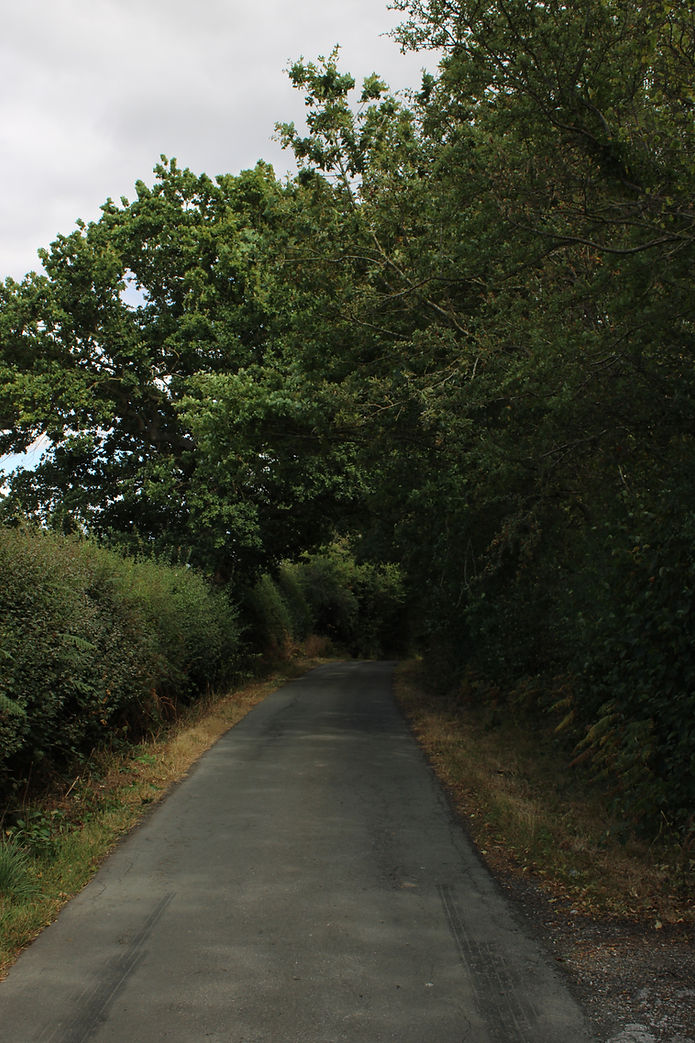
Bwgan-ddu Lane ~ Does the ghost of William Reynolds wander this lonely lane?
In the 250 years since, William Reynolds the hatter has largely been forgotten. His burial spot has instead attracted further legend - as is entirely predictable. It is said that the grave is actually that of a notorious highwayman, caught, hung and buried at Reynolds Grave, though there is no record of this. There is also a story of a famous fox being caught and buried here. But it has also been claimed that the lanes here are haunted, by a lonely figure wandering without direction. Curious that the tale of the ghost seems more grounded in truth than that of the highwayman. And what are we to make of the nearby lane by the name of Bwgan-ddu, the Black Ghost Lane (or Bogeyman)? Was the ghost of Reynolds seen wandering here - does he still?[4]
Some places are born dark, and they too are remembered.
Footnotes
1. The Oxford Magazine, (September 1771) p. 116
2. In Scotland, suicide was never officially recognised as a crime - officially.
3. The cross is no longer to be found, though it is possible it was turned inwards when the wall was rebuilt with the building of the Cricket field.
4. Bwgan-ddu Lane is south of Reynolds Grave, while the cross bearing and thus ghost denying Marchwiel Hall Lane is directly connected to Reynolds Grave.
Further Reading
The Oxford Magazine, September 1771
A.Edwards, The Tale of Reynolds Grave
C. Rees, History of the Parish of Marchwiel, Wrexham (1998)