


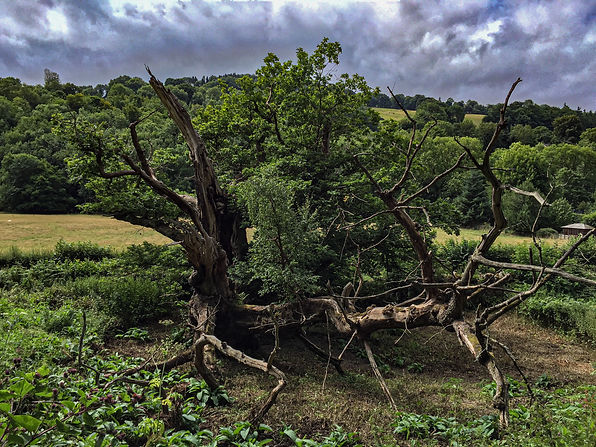
‘At last the King of England was enraged; and he moved his host into the wood of Dyffryn Ceiriog.’
Brut y Tywysogyon, Jones, Cardiff, (1952) p. 63
By the summer of 1165, the Welsh princedoms were once more in full open revolt against the English Crown. Henry II had thought the matter settled in 1163, having accepted the surrender of Rhys ap Gruffudd of Deheubarth in the field and forcing him,[1] along with Owain Gwynedd to do homage at his grand hunting lodge at Woodstock[2] in Oxfordshire. The princes of Wales were compelled to accept the King of England as their feudal overlord - an act that to Henry’s mind would bring the Welsh to heel. But to the Welsh, it was nothing short of a humiliation, and led to an almost immediate response - Rhys ap Gruffudd launching attacks[3] against the territories held by the Marcher Lord, Roger de Clare, overrunning Ceredigion.

Adwy’r Beddau - The Pass of the Graves. It is said the English dead were buried here, their graves still visible at the end of the 17th century.
By early 1165, Gwynedd was also on the offensive, with Dafydd, the son of Owain Gwynedd ravaging Tegeingl from his base in the Vale of Clwyd. A Welsh alliance was formed, the rarity of such an arrangement a testament to the real anger that was felt throughout Wales. The Welsh aim, it is said, was nothing short of independence from Angevin rule. Henry’s response was predictably one of indignation and fury.
Henry gathered his forces at Shrewsbury in the early summer of 1165 - an army described by various chroniclers, both English and Welsh as a mighty force. The Brut says of Henry’s army that it was, ‘a host beyond number of the picked warriors of England and Normandy and Flanders and Gascony and Anjou and all the North and Scotland,’[4] with the aim of completely subjugating the Welsh.[5] Why Henry chose Shrewsbury has been the object of some debate, but probably reflects his uncertainty as to who to attack first - Rhys or Owain. It may have been that even at this late stage of mustering his forces, Henry had hopes of a fragmenting Welsh alliance, perhaps hoping that Powys, both north and south, would return to his protection. In the event, having gathered at Shrewsbury and with Powys remaining within the Welsh alliance, Henry seems to have decided on Owain as his primary target and moved his army to Oswestry. In response, the Welsh gathered their forces at Corwen, possibly within the confines of the ancient hillfort of Caer Drewyn.
At this point, the Brut describes something of a lull, a stand-off, a reluctance to engage on both sides, ‘without the one daring to attack the other.’ Given the size of Henry’s army, it would seem eminently sensible for the Welsh to avoid a pitched battle, resting instead on the tried and tested tactics of hit and run, using the mountains and woods to their advantage. And given Henry’s well known skin-thin patience and propensity to rage, the Welsh were surely relying on Henry blinking first.
However long Henry waited at Oswestry was too long for the King of England, and eventually, his patience exhausted, English forces were ordered to move into the Ceiriog Valley, cutting down the woods as they moved in order to force a way through to Welsh forces encamped below the Berwyns at Corwen. And it is at this point that events become confused to the point of transparency. What actually happened amongst the woods of the Ceiriog Valley in the Summer of 1165 has over the years become considerably embellished, but in fact the Brut seems clear on the events, if brief.
‘And there a few picked Welshmen, in the absence of their leaders, manfully and valorously resisted them. And many of the bravest on either side were slain.’
Brut y Tywysogyon, Cardiff, (1952) p. 63
Thus is the engagement that became known much later as the Battle of Crogen, and so heavily laden with desperate courage and national honour is described. And the Brut y Tywysogyon is still our best and nearest contemporary source of the conflict.

How are we to interpret the words of the Brut? What actually happened in the woods of the Ceiriog Valley? Much hinges on the Brut’s description of the English force that moved into the woods of the Ceiriog Valley as a ‘host’. This could be interpretated to mean a sizeable force - and it is probable it was seen as such by Humphrey Llwyd when writing his Chronica Walliae in 1559 and David Powel, who based his Historie of Cambria of 1584 on Llwyd’s earlier work. Both Llwyd’s and Powel’s work were retellings of the late 13th, early 14th century Brut y Tywysogyon. But in fact, 'host' can be read in a number of ways - as a multitude, also an army, but also as a force larger than that which confronted them. And we should also be wary of bias, of course - the inflation of numbers is not unusual in written depictions of battle.
Compare the description of the Brut with the 16th century interpretations of the Brut by Humphrey Llwyd and David Powel and one can begin to see how this briefly detailed fight within the woods of the Ceiriog Valley became something far more.
‘And the Kinge, understanding they were so nighe, was wonderful desyrouse of battail, and came to the ryver of Kyriog, and caused the woode to be hewn downe. And of the Welshman, understanding the passage, came a great number of best men, unknowinge to their captaines, and mette with Kinges vawarde where placed the pyked men of all the army, and there began a hote skirmishe, and worthie men slayne one either side.’
Llwyd, Chronica Walliae, p. 139
‘But the king understanding that they were so nigh, being wonderfull desirous of battel, came to the riuer Ceireoc, and caused the woods to be hewen downe. Whereupon a number of the Welshmen understanding the passage, unknowing to their captaines met with the kings ward, where were placed the piked men of all the armie, and there began a hote skirmish, where diuerse worthie men were slaine on either side.’
Powel, Historie of Cambria, p.221
Notice that neither Llwyd or Powel use the word ‘host’ to describe the English force that moved into the woods, though their description of the foe that faced the Welsh as, ‘piked men of all the armie’ does rather reflect a sizeable number. It has been said that these 16th century chroniclers mistranslated the Brut’s use of the word ‘picked’ as ‘piked’ and took that to mean an English army. It does feel that Llwyd and Powel had read the Brut’s description of the English force within the woods as a ‘host’ and taken that to mean an army - an understandable interpretation, perhaps. But then we also have their description of the fight, not as a battle, but rather a ‘hote skirmish’ in which a number of each side were killed. Curious.
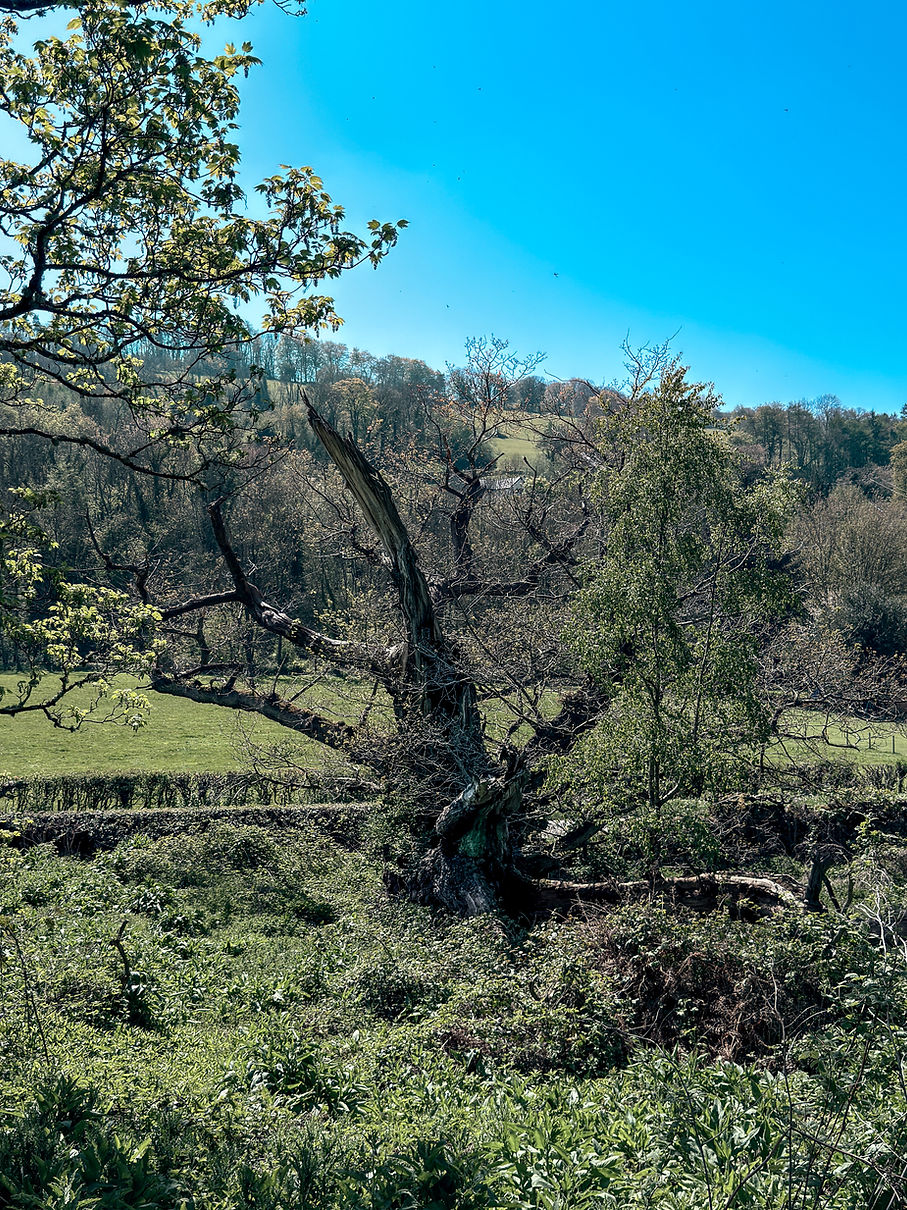
The Oak at the Gate of the Dead ~ this ancient, twisted oak was likely witness to whatever happened here in 1165.
Powel’s version in particular has been described as elevating the brief entry in the Brut into a full blown battle. But this is perhaps somewhat unfair. Powel’s telling of an entire English army in the woods of the Ceiriog Valley is not a world away from the Brut’s description of a ‘host’, but nowhere does Powel suggest a full blown battle. On the contrary, his description of the fight as a ‘hote skirmish’ suggests a brief but intense fight. But that in itself does not mean that the actual numbers of combatants was low. The Brut also describes many casualties.
However, Powel’s credibility as a source is rather soured by his insertion of a tale in which during the fight, Henry himself is saved from death by one Hubert de St Clare - who threw himself in the path of an arrow meant for the English King. In fact, this tale against this date, was first to be found in Holinshed’s Chronicles[6] which mistakenly dates the action to the invasion of 1165, but which actually originates from the Chronicle of Ralph Niger which describes the action as being at Brignorth in 1155, in which Henry II was acting to bring the rebellious Hugh de Mortimer to heel.[7] The inclusion of the king into the story, along with the suggestion that a fully armed English army was moving through the woods, seems to have helped to later inflate his earlier description of skirmish into a full blown battle. His use of the story is unfortunate, since it has reduced our faith in Powel as a source on the fight within the wood, though it would seem to have been an honest mistake, and led to the belief, the mistaken belief, that nothing actually happened within the woods of the Ceiriog Valley.
There is no explicit mention in the Brut of Henry being present at the fight, but part of the problem in coming to some kind of authoritative understanding of the events here, is that what little we are told can be interpretated in many ways. But we should not forget that Henry had experience of being ambushed in Welsh woods, having almost lost his life in the forests about Hawarden at the Battle of Coleshill in 1157, just eight years earlier. While the events at Coleshill would give credence to a large English force clearing the trees of the Ceiriog Valley, it would also make Henry’s presence there unlikely - unlikely, but certainly not impossible.
If we are to return to the Brut’s version of events, then, it seems a reasonable interpretation could be the following: a short, sharp engagement - an ambush of a large English vanguard of heavily armed infantry protecting a specialist group of woodsmen, by a hastily organised force of Welsh soldiery, perhaps anticipating just such an operation by the English but taken aback by the size of the enemy force. But despite being heavily outnumbered, the Welsh attacked and at speed. While the Welsh held the initial advantage with surprise, the numbers they faced, and perhaps the English expectation of a confrontation, meant that this was no Coleshill, but rather a more balanced affair in which the English held their own until their greater numbers began to tell - hence the many slain on both sides. There is also no suggestion that the English force was routed or even that, as at Coleshill, they were lucky to survive. On the contrary, it would seem though mauled somewhat, the English remained in the woods of the Ceiriog Valley and completed their mission, since the main force of Henry’s troops soon ascended the south face of the Berwyn’s on their way to Corwen - unlikely if the woods remained unfelled. This ‘hote skirmish’ in the Ceiriog Woods was a brief, brutal, bloody little engagement.
In the centuries following the publication of Powel’s Cambria, his work became the primary source for Welsh history - well into the 20th century. But while Powel’s work has lessened in importance, as the tremendous amount of scholarly investigation into the Welsh past has thrown a greater and more accurate light on events, it has, rather ironically, led, it seems to a lessening of the events in the Ceiriog Valley in the summer of 1165, to the point where some question whether a fight here happened at all.
It is undoubtedly true to say that Powel’s work is flawed as a reliable source, but it seems a little unfair to entirely dismiss the fight in the Ceiriog Valley - we have the Brut after all, and Powel’s (and Llwyd’s) version of events of 1165, while embellished is an interpretation of its passages, not an invention, the unfortunate Holinshed insertion aside. This skirmish in the Valley is also likely a victim of the increasingly weighty opinion that Henry II’s invasion of Wales in 1165 was a disastrous and largely bloodless failure, in which the King of England was not defeated by Welsh soldiery, but rather by the Welsh weather. Following the engagement in the Ceiriog Valley, Henry’s forces pushed on, climbing into the Berwyns above Chirk, following a trail, still known as Ffordd y Saeson, towards Corwen. Battered en route by atrocious weather,[8] in which it is said many soldiers died of exposure, the English eventually faced a Welsh army under Owain Gwynedd encamped across the valley from them within the confines of Caer Drewyn. After a while of waiting, neither side seemingly interested in making the first move, Henry upped sticks and marched his forces back to Shrewsbury, where he ordered the maiming of Welsh hostages, including two of Owain’s sons and a son of Rhys. In the absence of a pitched battle, and the damp withering away of Henry’s invasion, the skirmish within the Ceiriog Valley has seen, over the years, a reduction in stature to the point where it is doubted, by some, to have happened.
Even amongst those that do not doubt that there was a skirmish in the Ceiriog Valley, there has been some confusion as to its location. The Brut is clear enough in placing it at Dyffryn Keiriawc, while the O Oes Gwrtheryn, a Gwynedd chronicle from the end of the 13th century names the site of the fight as Coed Ceirjawg. However, what is not clear from the chronicles, of course, is exactly where within the woods the skirmish was fought. You will remember that Llwyd and Powel claim that the English forces came to the Afon Ceiriog. Today, tradition and now signage has placed the fight specifically within the gap in Offa’s Dyke at the Afon Ceiriog, below Chirk Castle and what is now the B4500. And it is true that the area retains the name, Adwy’r Beddau - the Pass of the Graves, but how old this name actually is and whether it is contemporary to the fight is unknown.[9] And then of course there is the no small matter of the remarkable oak tree, known now as the Oak at the Gate of the Dead - a deeply ancient, broken and twisted thing said to be on the site of a mass grave of the dead of the skirmish; graves that were said by Wynne, writing in 1697, to be still visible. So, what are we to make of the belief that this fight occurred within the woods here? Well, it has been my experience that one should question tradition with caution, since tradition often has its roots in the truth of a thing. There is a sensible question to be asked as to whether Henry’s route out of Oswestry would have brought him into the Ceiriog Valley further west, but still… there is that weight of tradition to be considered. [10]
I have, to this point, avoided naming the fight as it is popularly known elsewhere - The Battle of Crogen. William Wynne’s version of Powel’s History of Cambria[11] from 1697 identifies the fight in the Ceiriog Valley as being below the Castle of Crogen.
‘King Henry the Second in his expedition against the Welch to the mountains of Berwyn, lay a while at Oswestre, during which time he detached a number of his Men to try the Passages into Wales, who as they would have passed Offa’s Ditch at the Castle of Crogen, at which place there was a narrow way through att that country, and bears the old Name.’
Wynne, p.223
At no point does Wynne name the skirmish after the Castle of Crogen - the name by which Chirk Castle was for some time popularly known. Current thinking places Crogen Castle at Llanderfel on the outskirts of Bala, and Wynne would seem to have been influenced by a number of local Crogen placenames in the vicinity of the Ceiriog Valley in assigning the 13th century Marcher fortress an older provenance.[12] It would seem to be Thomas Pennant, writing at the end of the 18th century, and with Powel and Wynne his foundation, that first names this ‘hote skirmish’ in the Ceiriog Valley as the Battle of Crogen - the name by which it has been mistakenly known ever since.
‘This conflict is sometimes called the battle of Corwen but with more propriety that of Crogen, for it happened beneath Castelh Crogen, the present Chirk Castle; and the place is still called Adwy'r Beddau, or the pass of the graves of the men who were slain here.'
Pennant, Vol I, p.345
Pennant also takes the opportunity to add considerably to the description of the skirmish in the woods. Take a pinch, and just a pinch mind, of Brut, add a dollop of Llwyd, Powel and Wynne, throw in a hefty seasoning of Pennant’s excitement and you have his telling of this Battle of Crogen.
‘The King, hearing that his antagonist [Owain Gwynedd] was so near, resolved to bring the matter to a speedy decision. He marched towards him; and in this valley [Ceiriog], finding himself tangled in impenetrable woods, and recollecting his ill fortune among the woods of Eulo, directed his vanguard to make the passage clear by cutting down the trees, in order to secure himself from ambuscade. The pikemen, and flower of his army were posted to cover the workmen. The spirit of the common soldiers of the Welsh army grew indignant of this attempt, and without the knowledge of their officers, fell with unspeakable fury on these troops. The contest was violent, numbers of brave men perished.’
Pennant, Tour in Wales Vol I, p. 344

So, despite the fact that Powel seems to have gained the reputation of embellishing the fight amongst the woods of the Ceiriog Valley, it would seem to be Thomas Pennant that has elevated this skirmish into what it is known as today, both in name and stature. He would seem to have refined the tale as told by the Brut, Llwyd, Powel and Wynne into the Battle of Crogen. Previous chroniclers aside, I think Lloyd, writing of the skirmish at the beginning of the 20th century, has much the right of it, eschewing almost everything but the Brut.
‘The English army moved westward from Oswestry and soon found itself in the thick forest growth of the Ceiriog Valley. Here it was received by a band of skirmishers, who, although without regular leaders, boldly harassed the invaders from the shelter of the overhanging woods and did no small execution.’[13]
Lloyd, p. 516
Today, a walk down from Chirk Castle along Offa’s Dyke, will bring you to the Oak at the Gate of the Dead - quite the most extraordinary of ancient trees. This, you will remember, is said to mark the spot at which the English dead were buried. A little further on along the path will bring you to some modern signage, telling the tale of the Battle of Crogen as written of by Pennant. A wander further still will bring you to the road, across which is the old Castle Mill and the bridge across the Afon Ceiriog, upon which the plaque commemorating the Battle has been placed.
Quite where exactly this ‘hote skirmish’ in the Ceiriog Valley was fought is unknown, and but for some considerable fortune probably always will be. But tradition still counts for something, and I’d wager, as it is with me, a wander here will have you pausing and listening, perhaps for the clash of arms.[14]
Footnotes
1. Hostages were taken, and both Owain and Rhys were allowed to remain in control of their kingdoms.
2. This treaty is not to be confused with the Treaty of Woodstock of 1247, in which Llywelyn ap Gruffudd and his older brother, Owain ap Gruffudd were forced by Henry III to divide between them Gwynedd Uwch Conwy, that part of Gwynedd west of the River Conwy.
3. Rhy’s beloved nephew, Einon ab Anarawd had been treacherously murdered in his sleep by one of his own men, one Walter ap Llywarch, who was then given shelter by Roger de Clare.
4. Jones, (1952), p. 63
5. Perhaps, although this is not certain. It may have been that Henry was willing to retain the status quo - it might be that at this point, to Rhys and Owain this amounted to total subjugation.
6. ‘But yet I find in other authors, that in this iournie king Henrie did not greatlie preuaile against his enimies, but rather lost manie of his men of warre, both horssemen and footmen: for by his seuere proceeding against them, he rather made them more eger to séeke reuenge, than quieted them in any tumult. They tooke the castell of Cardigan, and in besieging of Briges, the king was in no small danger of his life: for one of the enimies shooting directlie at him, had persed him through the bodie if Hubert de Saint Clere conestable of Colchester, perceiuing the arrow coming had not thrust himselfe betwixt the king and the same arrow, and so preseruing his maister, receiued the stripe himselfe’. Chronicles of England, Scotland and Ireland Vol II, p.126
7. ‘In this siege of Bridgnorth in the earldom of Hugh Mortimer, when the same king [Henry II] was sought by a certain arrow, a particular one of his peers, namely Hubert St Clare, constable of Colchester, put himself in his place with great judgement, and received death for his lord.’ Ralph Nigher, Chronicles - translated from the Latin.
8. There are those who struggle with the very idea that one may suffer exposure in the Berwyns in the summer months. To those I say - ‘Have you ever walked the Berwyns?’
9. It was, however, current by the end of the 18th century.
10. Not to be a curmudgeon, but should we fairly ask as to whether the land about Offa’s Dyke would have been thickly wooded in 1165?
11. Which itself was a version of the Brut through its interpretation by Llwyd and Powel.
12. Llanderfel and Bala are not the greatest distance from Corwen and do skirt the Berwyns. But the Brut and everyone after is clear that Henry was active in the Ceiriog Valley, so it would seem unlikely that Wynne's mention of Crogen Castle was not a mistaken identification of Chirk Castle.
13. Lloyd was of a mind to place the skirmish in the vicinity of Tregeiriog between Llanarmon Dyffryn Ceiriog and Glyn Ceiriog, based on his estimation of Henry’s route from Oswestry to Corwen.
14. As an aside, it is worth noting that we know next to nothing as to any actual individuals present at this ‘Battle of Crogen’ However, there is a persistent tradition that one Llewelyn ap Ynyr of Ial of Bodidris was present and fought. In conversation with Owain Gwynedd after the Battle, Llewelyn accidentally drew his left hand, smeared with blood, across his sword, leaving an imprint of his bloody fingers. In memory of this, Owain ordered that Llewelyn carry a similar mark upon his shield, granting him a paly of eight, argent and gules.
Further Reading
Anon, Heraldry, Archaeologia Cambrensis, (1846)
T. Jones, Brut Y Tywysogyon, Cardiff, (1952)
J. E. Lloyd, A History of Wales From The Earliest Times To The Edwardian Conquest Vol. 2, London, (1911)
H. Llwyd, Chronica Walliae, (1559), ed. J. Beverley Smith, Cardiff, (2016)
T. Pennant, Tours in Wales, Vol. I, (1778) ed. J. Rhys, Caernarvon, (1883)
D. Powell, The Historie of Cambria, now called Wales, (1584)
W. Wynne, The History of Wales, London, (1697)