


In the grounds of Dolhyfryd, a little over a mile to south west of Denbigh is the head stone of the medieval cross that once stood at the Carmelite Friary in what are now the suburbs of the town. It was found in the first half of the 19th century within the grounds of the Friary by a Dr Cumming, a medical practitioner working at the former North Wales Hospital in Denbigh.[1] Cumming was an active antiquarian and was likely visiting the Friary in an attempt to ensure some kind of preservation of the building and what contents remained, given that it was falling into a greater state of decrepitude with each passing year. There does not seem to be any information regarding the circumstances of the find, but Cumming removed the cross head to his home at Dolhyfryd in an effort to preserve it from further neglect. It was placed by the well at Dolhyfryd where it stayed for many years, until the property was sold to a Mr Blackwell who removed it to a position beside his home - probably where it still resides.

The west face ~ Crucifixion with emblems of The Passion.
Elias Owen visited Dolhyfryd at the end of the 19th century and took some sketches of the head stone. He noted the condition of the cross, mindful that the four faces of the stone had suffered some considerable wear and tear.
‘The subjects are sculptured in relief, are more or less defaced by the action of the elements or other causes.’
E. Owen, Old Stone Crosses of the Vale of Clwyd, (1886) p. 32
It is a shame that we have no information regarding the discovery of the cross head other than it was found by Dr Cumming. Was it upon the ground, having been brought low during the Reformation? Was it independent of the cross shaft, which may have found itself removed to Rug Chapel on the outskirts of Corwen? Was it perhaps buried? On examination, Owen seems to be unsure as to whether the cross was intentionally mutilated or simply worn by the elements. And while there has been some further weathering in the near two centuries it has stood at Dolhyfryd, much of what Owen sketched is still visible today - especially what would have been the west facing Crucifixion.

The east face ~ Mary with Child.
It is a startling piece - largely because one is able to approach the head so very closely. It has been placed on a small brick plinth and concrete cap[2] and is entirely, wonderfully open to close study and scrutiny. As said, the ubiquitous Crucifixion is very clear. Owen described the scene to be flanked with the emblems of the Passion - pincers, nails and hammer and scourges to the right, along with a ladder and spear to the left. These last are perhaps not as clear as when Owen leaned in upon the cross head at the end of the 19th century - but they are still recognisable. On what would have been the east face of the cross, the Virgin with Child is still clear enough. Owen describes how her hair falls over a shoulder, but again this is no longer clear. The sides of the cross are now more obscure than in Owen’s time, though it is clear that the ecclesiastic in the south facing niche is, as Owen described, clearly in an act of devotion - at prayer. There was in Owen’s time clear evidence of a robe, chasuble, maniple and alb, but time has robbed us of these little wonders. Within the north facing niche is a figure which is likely to represent St John, as found on many other crossheads. He is said to be holding a book.
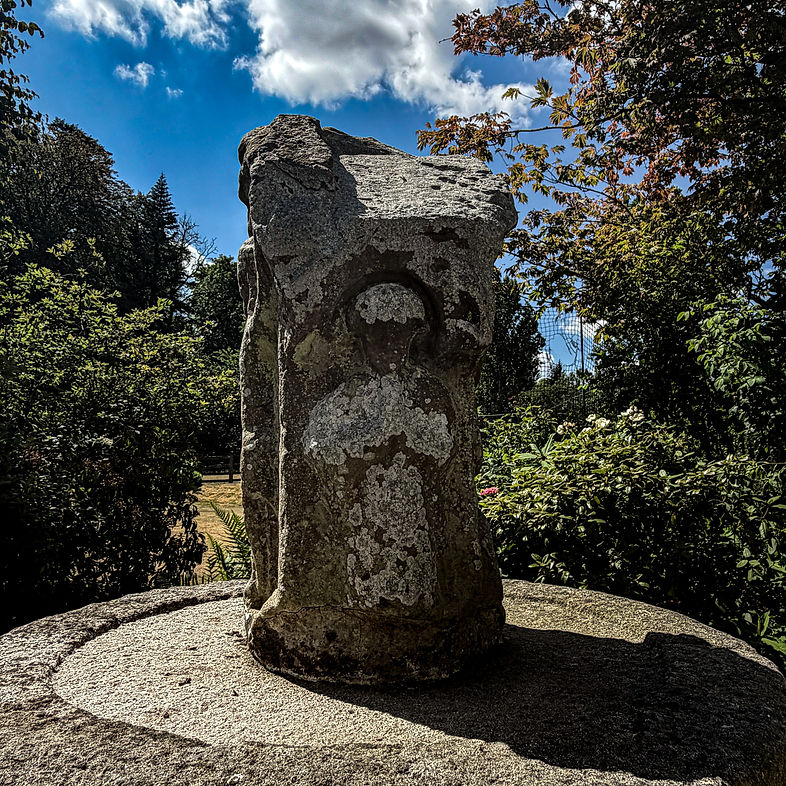
The south face ~ Cleric at prayer.
It is extremely rare to be able to approach a medieval crosshead so closely - a privilege, in truth. Most were destroyed, some have survived atop their cross shafts at some height. There are two others in our little fief that are as open to view - the curious crosshead in St Saernan’s in Llanynys, and the wonder that is the tabernacle in the grounds of Corpus Christi in Tremeirchion, upon a short modern shaft. But the crosshead at Dolhyfryd is something a little bit otherwise - it speaks a little differently for reasons I shall put my finger on eventually, I'm sure.

The north face ~ St John with book.
As to its age, Owen was of a mind to suggest it was originally early 14th century, although held out the possibility of it dating to the foundation of the Friary itself - 1291. A date closer to the end of the 14th century or early 15th century might be closer to the truth, but I’m not overly minded to gainsay Owen. Hush my mouth should I think to do so. There was a time when medieval crosses were so common as to be almost invisible for their vast numbers. But they were the victims of religious change, of neglect and time - the inexorable step of time. Most have gone, lost and ruined. Those that remain have become what they perhaps lost in their heyday - looked upon wonders. And the crosshead at Dolhyfryd is no different.
*Please be aware that Dolhyfryd is a private residence. The property is open only on certain days of the year through the National Gardens Scheme. Please check on their website for opening times.*
Footnotes
1. Dr Cumming was also, likely as not the same individual who is recognised as one of the subscribers of the Book of Common Prayer published by the Clwydian Press in 1823.
2. Coflein describes it as a ‘bird bath stand’.
Further Reading
E. Owen, Old Stone Crosses of the Vale of Clwyd, Oswestry & Wrexham, (1886)
R. J. Silvester & R. Hankinson, Medieval Crosses and Crossheads, CPAT Report No. 1036, (March 2010)